

A total of 14 teams will qualify for the 2026 NFL Playoffs – seven from the AFC and seven from the NFC.
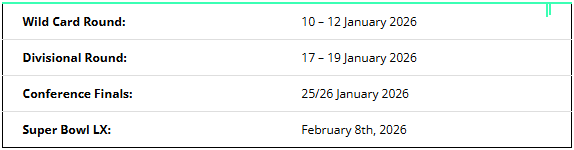
The 2026 NFL Playoffs kick off on January 10 with the Wildcard Round.
The following week, the Divisional Round and then the Conference Championships are on the schedule. This will decide who will play in Super Bowl LX on February 8, 2026.
Here you can find all the information about the NFL Playoffs 2026: Schedule, dates, teams, playoff picture and the explanation of how the playoffs with seeding list work.
NFL Playoffs 2026 Schedule & Dates until the Super Bowl
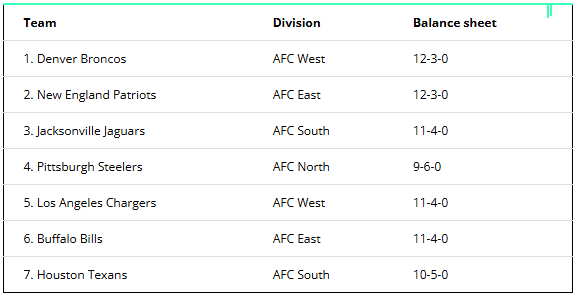
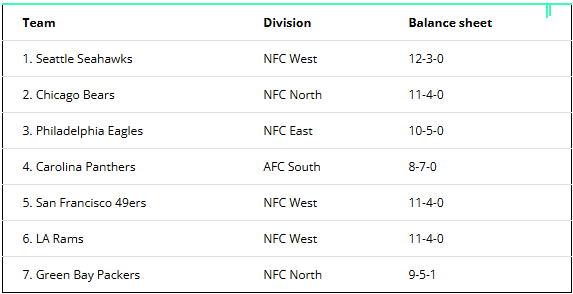
NFL Playoffs 2026 as of now: Who is qualified?
NFL Playoffs – Schedule Wild Card Round
AFC:
- #7 HOU Texans @ #2 NE Patriots
- #6 BUF Bills @ #3 JAX Jaguars
- #5 LA Chargers @ #4 PIT Steelers
- #1 DEN Broncos – Bye-Week
NFC:
- #7 GB Packers @ #2 CHI Bears
- #6 LA Rams @ #3 PHI Eagles
- #5 SF 49ers @ #4 CAR Panthers
- #1 SEA Seahawks – Bye-Week
Note: The #1 teams from each conference have a bye in the first round of the Wild Card Round and will not enter until the second round of the 2025 NFL Playoffs.
View this post on Instagram
How many teams will make it to the 2026 NFL Playoffs?
A total of 32 teams play in the NFL. The National Football League is divided into two conferences, the American Football Conference (AFC) and the National Football Conference (NFC).
The AFC and NFC are each divided into four divisions of four teams. In the regular season, each team plays 17 games.
After the last matchday, seven teams each from NFC and AFC qualify for the playoffs.
The four division winners of each conference are fixed, the other three places are awarded to the teams with the best win-loss ratio.
The division winner with the best record is seeded #1, the division winner with the worst record is seeded #4.
In addition, there are the three teams with the best record in the regular season that are not division champions. The team with the best record is seeded #5, the team with the weakest is seeded #7.
The wild cards go to the two best teams in each conference that failed to win their division.
This makes it possible that the seven most successful teams in a conference will not automatically advance to the playoffs.
Playoffs Schedule & Dates – from the Wildcard Round to the Super Bowl
According to the NFL schedule of the regular season, the playoffs continue. Without a break.
The 2026 NFL Playoffs begin on January 10 and end on February 8 with Super Bowl LX.
The playoffs (also known as the post-season) are made up of four rounds – the Wild Card Round, the Divisional Round, the Championship Games (also known as the Conference Finals) and the Super Bowl.
In the playoffs, the winner of the respective conference is then determined according to the knockout principle.
The two Conference Champions, who were determined in the Championship Games or Conference Finals (equivalent to a “semi-final”) are in the NFL Finals – i.e. in the Super Bowl.
Wildcard Round – who plays against whom?
The first round of the play-offs is also called “Wild Card Games” in technical jargon.
The best teams in the AFC and NFC after the regular season – from now on the “First Seed” – have a bye in the 1st round of the NFL Playoffs and only enter in the second round.
The other six teams from the respective divisions already play in the 1st round of the NFL Playoffs.
The format looks like this: The second-best team in the respective conference plays against the seventh-best, the third-best against the sixth-best, and the number 4 of the regular season against the number 5.
The team with the better record from the regular season, i.e. the one with the lower seeding, has home rights. For example, the #2 against the #7.
The winners of the Wildcard Round will advance to the Divisional Round.
NFL Playoffs Teams of the Wild Card Round
AFC:
- #7 @ #2
- #6 @ #3
- #5 @ #4
NFC:
- #7 @ #2
- #6 @ #3
- #5 @ #4
(The #1 teams from each conference have a bye in the first round of the Wild Card Round and do not enter until the second round of the NFL Playoffs.)
Divisional Round: Now the top teams get in
The Divisional Round of the NFL Playoffs corresponds to the quarterfinals. Only eight teams are still there.
The two teams that finished the first round of their conference as the best team will now also intervene here. The two first seeds (seeded number 1 in the playoffs) now have home advantage.
#1 plays at home against the worst team according to the seeding list to win in the Wild Card Round. Accordingly, #2 will play against the team with the second-highest seed of this playoff round.
The winners of the Divisional Round are through to the Championship Games.
Championship Games: NFL Playoffs Semifinals
The penultimate round of the NFL Playoffs are the Championship Games or Conference Finals. Here it will be determined who will play in the Super Bowl!
The two winners of the Divisional Round will face each other in the AFC and NFC Conference Championship Games.
Home advantage in the “semi-finals” is again the team with the lower seed. The team that is ranked lower in the regular season has to play against a better team in the regular season.
For example, the #2 seed has the right to play at home in the Conference Finals in a duel with a #5 seed.
The winners of these games are not only winners of their conference, but they automatically qualify for the Super Bowl.
This means that in the Super Bowl, the winner of the AFC will play against the winner of the NFC.
The History of the NFL Playoffs
The NFL playoffs have been around since 1967, when the National Football League consisted of only 16 teams – half as many as today – which were divided into four divisions.
But: Just like today, the league was divided into two conferences – the AFC (American Football Conference) and the NFC (National Football Conference).
However, the playoff concept has been retained over all the years and has only been slightly adapted again and again.

